

Our Theory of Change: If we restore childhood independence, then we rebuild resilience.
Let Grow is a leading national nonprofit focused on restoring childhood independence. Central to this Theory of Change are Let Grow’s vision, mission, systems-based approach, and free programs for schools and families:
Vision
Let Grow envisions a world where schools, families, communities, and laws all align to give every child the independence they need to grow up with less anxiety, greater resilience, and the ability to thrive.
Mission
Let Grow’s mission is to make it easy, normal, and legal to give kids the independence they need to grow into capable, confident, and happy adults.
Approach
We take a systems-based approach, working in schools, with families, in communities, with policymakers, and with trusted institutions making independence repeatable and socially reinforced.
Core Programs
The Let Grow Experience
The Let Grow Experience is a simple, life-changing homework assignment: “Go home and do something new, on your own.” With their parents’ approval, students choose a developmentally appropriate activity, whether it’s climbing a tree, running an errand, making a meal, or something else they can do more for themselves. This monthly activity helps break the cycle of overprotection by giving children opportunities to act without parental help or supervision, while giving families a structured way to step back. Teachers assign the Experience, and parents see what their children can do on their own. This is an important part of how change takes place. Rather than simply asking parents to believe their child is capable, the Experience gives them an opportunity to see that capability for themselves. The program is free, flexible, and works across grade and ability levels. The K–8 version includes handouts, idea lists, and “reflection leaves” for students to complete. The high school Independence Inventory helps teens plan, practice, and reflect on larger steps toward self-sufficiency. Family and Summer Editions are also available. With each new experience, children have opportunities to plan, act independently, navigate what happens, reflect on what they learned, and build resilience, responsibility, and confidence through greater independence.
The Let Grow Play Club
The Let Grow Play Club, the brainchild of Let Grow co-founder and developmental psychologist Peter Gray, gives children time for unstructured, mixed-age, no-phones play. Gray’s research and synthesis of the developmental literature emphasize the role of self-directed play in helping children learn to solve problems, navigate peer relationships, regulate their behavior, and become more resilient. In Play Club, children create their own games, make decisions, and work through conflicts while adults supervise for safety without directing the play. This gives children repeated opportunities to practice autonomy and social problem-solving in a school setting. It can also support the development of an internal locus of control as children experience how their own choices and actions influence what happens.
The Problem & The Context
Over the past several decades, childhood has become safer, but also more supervised and restricted.
Beginning in the 1980s, highly publicized child abductions, the 24-hour news cycle, Stranger Danger campaigns, litigation concerns, and fear of public judgment helped change how adults perceived childhood risk. Psychologists Amos Tversky and Daniel Kahneman described this tendency through the availability heuristic, a mental shortcut that can shape how we judge risk, in their foundational article, “Availability: A Heuristic for Judging Frequency and Probability” (Cognitive Psychology, 1973). When frightening events are vivid, memorable, and repeatedly brought to our attention, we can perceive them as more common than they actually are. As rare dangers began to feel commonplace, adults responded with greater protection, leaving children with fewer opportunities to practice independence and discover what they could do on their own.
Yet by several important measures, childhood has become objectively safer. Violent crime has declined substantially since its early-1990s peak, and stranger abductions remain exceedingly rare. Many parents nevertheless feel less comfortable giving children independence and face real concerns about being judged, blamed, or even reported for allowing freedoms that were once considered ordinary.
Institutional and cultural pressures have reinforced this shift. Schools have become more risk-averse, children’s schedules more structured, and screens an increasingly common substitute for real-world exploration and play. Concerns about liability, safety, academic achievement, and public judgment can make greater adult supervision feel like the responsible default.
There is also a hidden toll on parents and educators. Adults are increasingly expected to anticipate problems, prevent mistakes, manage conflicts, and protect children from discomfort or failure. This can leave parents and educators carrying responsibility for experiences children once had more opportunities to navigate themselves.
Legal uncertainty can reinforce these pressures. Broad or unclear definitions of neglect can leave parents unsure whether allowing developmentally appropriate independence, such as walking to school, playing outside, or staying home briefly, could result in scrutiny or intervention. This can create a chilling effect, where fear of consequences discourages families from giving children ordinary opportunities for independence. Together, these cultural, institutional, and legal pressures can shape not only what parents allow, but what schools, communities, and other institutions view as normal and appropriate for children.
This matters because children develop through experience. Independent activity, free play, manageable risk, problem-solving, frustration, and occasional failure give children opportunities to make decisions, resolve conflicts, assess risk, and discover what they can handle. When these experiences become less common, there can be developmental, emotional, cognitive, social, and behavioral consequences, including fewer opportunities to build confidence, coping skills, problem-solving, risk assessment, creativity, social skills, and resilience. Greater dependence on adults can also reinforce the expectation that adults should continue to supervise and intervene.
Let Grow addresses this cycle by creating developmentally appropriate opportunities for children to experience greater independence, while giving parents and educators a structured way to step back.
Bottom line: Childhood has become safer. But safety alone does not build strength.
Core Assumptions: Three Developmental Truths
Let Grow’s programs are grounded in decades of research across psychology, neuroscience, sociology, and education. Giving children greater independence does not mean giving them less support. Greater independence gives children opportunities to develop the capabilities that parents, educators, and community members want them to carry into school, relationships, work, and life. Let Grow’s programs put three developmental truths into practice: children need autonomy, resilience develops through experience, and safety alone does not build strength.
Developmental Truth #1: Autonomy Is a Basic Human Need
Children need meaningful opportunities to make choices, take action, and discover what they can do for themselves.
Self-Determination Theory (Deci & Ryan, 1985) identifies autonomy, competence, and relatedness as basic psychological needs important to motivation and well-being. Edward Deci and Richard Ryan formally developed the theory in Intrinsic Motivation and Self-Determination in Human Behavior (1985). More recently, a major meta-analysis, “Disentangling autonomy-supportive and psychologically controlling parenting: A meta-analysis of self-determination theory’s dual process model across cultures”, published in American Psychologist (Bradshaw et al., 2025), encompassed 238 studies and more than 126,000 participants. It found that parental autonomy support was positively associated with child well-being across cultures, regions, developmental periods, and sexes.
Self-Efficacy Theory (Bandura, 1977) helps explain how successful independent experiences can build confidence. In his foundational article, “Self-Efficacy: Toward a Unifying Theory of Behavioral Change” (Psychological Review, 1977), psychologist Albert Bandura identified mastery experiences as an important source of self-efficacy. Children develop belief in their abilities in part by doing challenging things and experiencing themselves succeeding.
This has direct relevance for educators and parents. Adults remain important sources of guidance and support, but children also need opportunities to act without an adult directing every step. The Let Grow Experience creates these opportunities through developmentally appropriate, parent-approved activities that children undertake independently. When educators assign the Experience, they are not simply assigning homework. They are creating opportunities for mastery that allow children to experience their own capability and parents to see it for themselves. The Experience also gives children real-world opportunities to practice executive functioning skills such as planning, task initiation, flexibility, self-control, time management, and perseverance.
What this means: Independence is a developmental nutrient. Children need opportunities to act, choose, and discover what they can do.
Developmental Truth #2: Small Freedoms Build Resilience
Autonomy develops through experience, not explanation. Children build resilience when they encounter manageable challenges and have opportunities to work through them.
Developmental science also gives us reason to expect that manageable independent experiences may help reduce anxiety by building mastery, self-efficacy, and tolerance for uncertainty.
Exposure-based principles provide another explanation for why these experiences may matter for anxiety. Anxiety can be reinforced when feared or uncertain situations are consistently avoided. Repeated, manageable experiences give children opportunities to approach uncertainty, discover what they can handle, and build confidence through experience.
Developmental psychologist Ann Masten’s resilience research, including her landmark article “Ordinary Magic: Resilience Processes in Development” (American Psychologist, 2001), shows that resilience grows from ordinary adaptive systems and experiences rather than extraordinary circumstances. Building on this idea, children benefit from manageable challenges they have the capacity to navigate. Walking the dog, making a purchase, preparing food, resolving a disagreement, or managing free time can become real-world practice in decision-making, problem-solving, and emotional regulation.
Free play provides another setting for this development. Developmental psychologist and Let Grow co-founder Peter Gray has synthesized research on the developmental role of self-directed play, including in Free to learn: Why unleashing the instinct to play will make our children happier, more self-reliant, and better students for life (2013). His work emphasizes how free play gives children opportunities to make decisions, cooperate, solve problems, and resolve conflicts without continual adult direction. The Let Grow Play Club puts these principles into practice by providing appropriate adult oversight while leaving the play itself to children.
These experiences can also strengthen the parent-educator partnership. Schools provide a trusted setting in which independence can be encouraged, while parents see their children demonstrate capabilities that may not be as visible when adults regularly step in. If parents have concerns, educators can use this developmental framework to explain that the goal is not independence for its own sake. It is to give children developmentally appropriate opportunities to practice capability while caring adults remain available for guidance and support.
What this means: Small, everyday freedoms and manageable experiences practiced consistently end up building resilience.
Developmental Truth #3: Safety Is Not the Same as Strength
Children need safety. They also need opportunities to explore beyond the direct control of adults.
Attachment Theory, developed through the work of John Bowlby and Mary Ainsworth, helps explain why safety and independence are not contradictory. Bowlby formally developed the theory in Attachment and Loss, Volume 1: Attachment (1969), while Ainsworth and colleagues provided foundational empirical work in Patterns of attachment: A psychological study of the strange situation (1978). A central concept is the secure base: secure relationships give children a foundation from which to explore. The goal is not independence from caring adults, but the confidence to venture out knowing that support remains available.
Maslow’s Hierarchy of Needs, introduced by psychologist Abraham Maslow in “A Theory of Human Motivation” (Psychological Review, 1943), offers another framework familiar to many educators. Safety and love are foundational needs, but they are not the endpoint of development. Maslow’s framework moves toward esteem and self-actualization. Safety can provide a foundation from which children can explore, take on challenges, develop competence, and grow.
Problems arise when protection eliminates too many opportunities for manageable challenges. In The Coddling of the American Mind (2018), Let Grow co-founder Jonathan Haidt and Greg Lukianoff use the term “safetyism” to describe a culture in which safety becomes a value so dominant that it can interfere with other priorities and experiences that help people develop strength.
This distinction can be particularly useful in conversations between educators and parents. Supporting independence does not mean abandoning appropriate safeguards. Helmets, seatbelts, crosswalks, accessibility supports, clear boundaries, and adult judgment remain important. The useful distinction is between appropriate safety and unnecessary adult control. That distinction matters beyond individual families and schools, too, because community norms, professional guidance, institutional practices, and public policy can all influence how much independence children are able to experience. Let Grow asks parents and educators to provide appropriate safeguards while still giving children room to practice autonomy, judgment, and responsibility.
What this means: Love and safety should launch independence, not limit it.
From Fear to Trust: Let Grow’s Fear Loop / Trust Loop Framework
The three developmental truths help explain how greater independence can change the way children and adults respond to fear. Let Grow’s Fear Loop / Trust Loop Framework illustrates two reinforcing cycles that can take hold. When adults respond to fear with greater control, children have fewer opportunities to develop autonomy and confidence. Let Grow describes this as the Fear Loop:
The Fear Loop
Fear of harm → More control → Reduced autonomy → Heightened anxiety → More fear
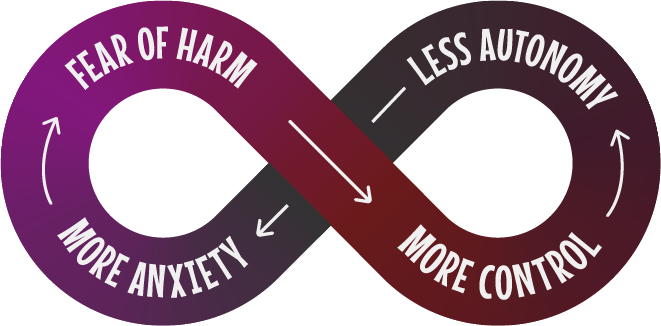
Breaking that cycle requires more than reassurance.
Let Grow proposes the reverse reinforcing cycle as the Trust Loop. Action is an antidote to fear. When children have developmentally appropriate opportunities to act independently, they gain real experience handling challenges for themselves. Parents and educators also get to see what children can do. The experience provides new evidence of capability, and that evidence can lead to the Trust Loop:
The Trust Loop
Trust in competence → Independent experiences → Mastery and confidence → Reduced anxiety → More trust
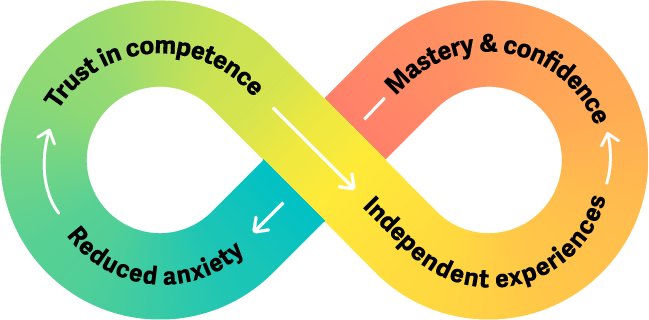
But for the Trust Loop to begin, adults first have to be willing to give children greater independence.
The Theory of Planned Behavior, presented by psychologist Icek Ajzen in “The Theory of Planned Behavior” (Organizational Behavior and Human Decision Processes, 1991), helps explain what can influence that decision. The theory proposes that attitudes toward a behavior, subjective norms, and perceived behavioral control help predict a person’s intention to act. Intentions and perceptions of behavioral control help predict actual behavior. Applied to childhood independence, adults may be more likely to intend to provide appropriate independence when they believe it benefits children, perceive that important people and institutions support it, and believe they have the ability and opportunity to do so.
For educators, this is the rationale working in practice. The independent activity is not only an experience for the child. It gives parents and educators new information about what that child is ready and able to do. The Experience reinforces this process by inviting children and parents to reflect on what happened and what they learned when the adult stepped back. And when a school supports these opportunities, it helps make childhood independence feel more normal and doable for families. The same principle operates beyond the school. When families see independence supported by schools, health professionals, community leaders, policymakers and laws, along with other trusted institutions, it can help shift the broader norms around what children are capable of and what constitutes a healthy, developmentally appropriate childhood.
Let Grow’s programs create opportunities to put this cycle into practice. The Let Grow Experience gives children developmentally appropriate, parent-approved opportunities to do something independently. The Let Grow Play Club gives children time and space to direct their own play, solve problems, and navigate relationships with less adult intervention.
Action disrupts the Fear Loop and builds capability. Capability builds trust. Trust makes more independence possible.
Inputs & Activities
Inputs
Let Grow draws on decades of developmental science, free and scalable program models, educator and family resources, research and evaluation, and partnerships across schools, communities, and bipartisan policy.
Activities
Let Grow puts these resources into practice by:
- Providing, free of charge, the Let Grow Experience and Let Grow Play Club to schools as programs designed to support Tier 1 MTSS (Multi-Tiered System of Supports) as a universal, preventative foundation for social-emotional growth, along with resources that help educators implement the programs and communicate with families.
- Providing foundational activities to schools, counselors, and health professionals that can complement Tier 2 and Tier 3 MTSS interventions, while also informing the emerging clinical application of these principles through Independence Therapy.
- Providing families with practical tools and developmentally appropriate opportunities to give children greater independence.
- Supporting research and evaluation to measure outcomes and strengthen the evidence behind Let Grow’s programs.
- Building partnerships and engaging trusted voices to share stories and evidence that help make childhood independence more visible, understood, and accepted.
- Advancing bipartisan Reasonable Childhood Independence laws, a rare area of agreement among lawmakers, child development experts, parenting advocates, child welfare professionals, and equity-focused leaders. These laws clarify when childhood independence is not neglect and protect parents’ ability to give children developmentally appropriate independence.
These activities give children repeated opportunities for independence and child-directed play, while giving parents and educators opportunities to see what children can do when adults step back. These experiences are expected to build mastery and capability in children, strengthen adult trust, make further opportunities for independence more likely, and ultimately support more capable, confident, and resilient children.
Reach & Adoption
Let Grow tracks outputs and indicators of reach and adoption. In 2026, Let Grow programs are being used in more than a thousand schools, and tens of thousands of parents and families have downloaded Let Grow materials. And since 2018, Let Grow has helped pass bipartisan Reasonable Childhood Independence laws in 13 states, supported a statewide resolution in California, and supported the introduction of the bipartisan Promoting Childhood Independence and Resilience Act at the federal level.
Expected Outcomes & Impact
Let Grow expects change to begin with children and extend to the adults and environments around them.
Children
Greater autonomy, confidence, self-efficacy, problem-solving, sense of agency, emotional regulation, social skills, and resilience, along with reduced anxiety around manageable challenges and independent action. Children become more willing to try new things, navigate manageable challenges, and act without immediately relying on adult intervention.
Parents and Families
Greater confidence in children’s capabilities, less catastrophizing and anxiety around appropriate independence, and more willingness to step back as children demonstrate what they can handle.
Educators and Schools
Students have more opportunities to practice responsibility, problem-solving, cooperation, and independence. Educators gain a shared framework for understanding the developmental rationale behind appropriate autonomy and free play, greater confidence explaining the evidence behind Let Grow’s programs, and practical language for discussing these principles with families, counselors, school leaders, and district administrators.
Communities, Advocates, and Policy
Greater acceptance of children being independently present in their neighborhoods and public spaces. Greater understanding and support for developmentally appropriate independence among trusted voices and institutions. Laws and policies that support children’s opportunities for appropriate independence.
Long-Term Impact
Let Grow’s long-term goal is to help restore childhood independence as a normal part of growing up. As children gain experience, they develop capability. As parents and educators see that capability, they gain confidence to provide more opportunities for independence. Over time, the Trust Loop becomes easier to sustain at home, at school, in the broader community, and across the institutions and policies that help shape childhood.
The intended impact: More capable, confident, and resilient children, supported by adults who trust them to grow.
Measurement & Learning
Let Grow’s evidence base operates at two levels. First, Let Grow’s programs are evidence-informed: the mechanisms underlying them are grounded in decades of developmental science (presented within this Theory of Change), including research on autonomy, self-efficacy, resilience, attachment, and free play. Second, Let Grow is building more research and evaluation into its programs to continue to test whether the expected outcomes occur when these principles are put into practice.
Current and planned evaluation includes child, parent, and educator measures of autonomy, confidence, anxiety, independence behaviors, and attitudes toward children’s capabilities. This work includes program impact surveys, comparisons between families who practice Let Grow programs and parents nationally, and educator feedback. It also includes independent clinical research examining the relationship between childhood independence and anxiety.
Findings and feedback from children, families, educators, researchers, and trusted partners are used to refine Let Grow’s programs, strengthen the evidence base, and identify where further study is needed.
Put the Science Into Practice
Let Grow offers several practical ways to put the science of childhood independence into action. Educators can bring the free Let Grow Experience and Let Grow Play Club to their schools. To learn more or to get started, visit letgrow.org/program/educators or email schools@letgrow.org.
Parents and families can use the Family and Summer Editions of the Let Grow Experience to create more opportunities for independence at home and in everyday life. Policymakers and advocates can work with Let Grow to advance Reasonable Childhood Independence laws and policies. And health professionals, corporate partners, community leaders, and other advocates can partner with Let Grow to help make childhood independence more understood, accepted, and supported.
Want to talk more about the research? Please email the Let Grow team at info@letgrow.org.