






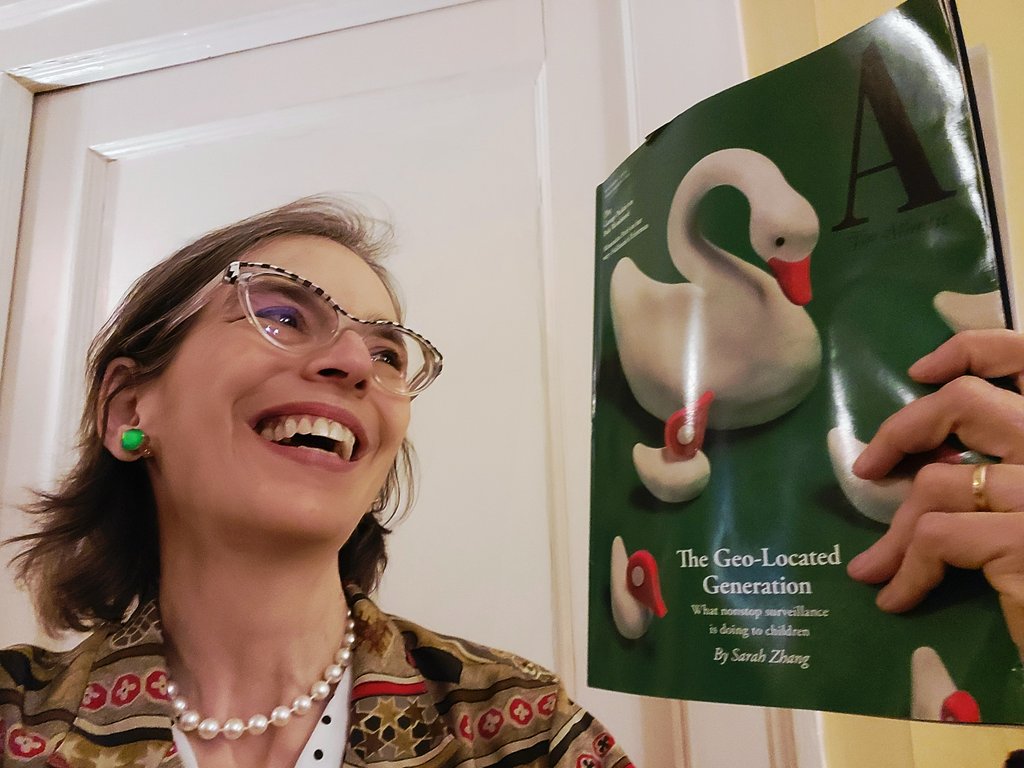
The Atlantic Tracks Let Grow in “The Geo-Located Generation”
Spoiler Alert: The huge and thrilling cover story in the Atlantic this month ends with a plea: Let kids start doing things on their own and everyone’s better off – the kids, the parents, the community.
If that sounds like what Let Grow has been shouting from the rooftops for about 10 years, it is. And happily, the Atlantic author, Sarah Zhang, gives us a ton of credit.
In “The Geo-Located Generation: What nonstop surveillance is doing to children,” Zhang notes that it is harder than ever to let go/let Grow in a culture that provides parents with constant updates on their kids via baby monitors, school portals, Whatsapp groups and more. No issue is too small! Zhang literally got a message about her daughter’s paper cut.
Tracking and peace of mind
But of course it is location tracking that is the most common way parents keep tabs on their kids, and that’s what the article explores in depth.
Obviously tracking is extremely convenient: You can check if your kid is heading home and start making dinner, or if they are where they said they’d be. But does this ability to check deliver its big promise: peace of mind?
Let Grow believes in one big thing
Allow me to quote Zhang quoting me:
Skenazy is one of the foremost public advocates against this need to “check, check, check, check” on your kids, a position she held long before their phones were beaming their location into our pockets.
In 2008, as a columnist for The New York Sun, she wrote about leaving her 9-year-old at a Manhattan Bloomingdale’s with a subway map, a MetroCard, and $20 to find his way home alone. He made it, “ecstatic with independence,” she wrote, but her actions provoked such hostile backlash, she was inspired to a new life’s mission. She came out with a book, Free-Range Kids, and a reality-TV show, World’s Worst Mom, where she coaxed overprotective parents to, for example, let their tween daughter use a public bathroom by herself.
Skenazy also co-founded the nonprofit Let Grow to promote kids’ independence, along with Daniel Shuchman, a private investor and philanthropist; Jonathan Haidt, a social psychologist best known as the author of the anti-phone treatise The Anxious Generation; and Peter Gray, an evolutionary psychologist who recently came out with his own book blaming the decline in teen mental health on schools, rather than phones. Let Grow’s founders may disagree on why, but they do all agree that society is squelching kids’ independence—to their detriment.
Independence down, anxiety up
Agree on this we sure do! And here’s why: As kids’ independence has been going down over the years, their anxiety has been going up.
Zhang quotes a UK study that found the number of kids aged 7-8 walking to school from 1971 to 2010 plummeted from 80% to 6%.
Six percent!
The problem is not just that constantly supervised kids “absorb the sense that danger can lurk around every street corner, because it’s what their parents taught them,” Zhang wrote. It’s also that they don’t get to solve any problems on their own. We’re there to solve them first!
The Facebook moms
Zhang tells of a mom in a Facebook group for college parents who was tracking her kid. One morning she saw that her child (or at least her child’s phone) was still in her room. But she had a math test in 10 minutes! Typed the mom: “Could someone ask their kid to go knock on her door?”
Ah, but how does that kid learn to deal with messing up? How does that mom learn to deal with a kid who messes up?
When kids are very young, naturally an older person must be there to soothe and supervise. But (as I have explained here), Mother Nature programmed kids to gradually venture further and further out on their own. The parent goes from in the room with the child to inside their heart and mind. This is called maturing.
Culture’s big wrong turn
But today, parents are expected to never stop watching their kids. And not just via phones! You’ve heard of parents arrested for letting their kids walk around, or play outside.
This is where our culture took a wrong turn.
“[D]evelopmental psychology does suggest that constant monitoring eventually becomes unhealthy” for kids, writes Zhang. As parents, we, too, are “supposed to undergo our own transformation as our children grow, relinquishing the knowledge and control we once held.”
The Atlantic gets us!
Let Grow’s whole mission is to make that easy, normal and legal again. Actually, better than normal: GREAT!
Zhang writes:
Skenazy argues that the apps deprive parents of the opportunity to develop their own muscles: “There’s no reps of letting go of your kid, living without knowledge for a little while, and then returning safe and sound. And you’re realizing, “Wow, I don’t have to worry every single second.”
But if “hypervigilance is the only way to keep your kid safe, how can you ever stop watching?” Zhang asks.
Here’s how.
Change can start today
The only solution to this worry – the one Let Grow promotes through all our school programs, parent materials, webinars and endless public outreach – is by actually LETTING GO in REAL LIFE. This experience rewires the kid and the parent.
And now it’s being proven scientifically.
The Atlantic article goes on to describe the work of psychologist and Let Grow Advisory Board member Camilo Ortiz.
Ortiz was inspired by the Let Grow Experience – our free curriculum for teachers and counselors that gives kids the homework assignment, “Go home and do something new on your own, with your parents’ permission, but without your parents.”
Independence as therapy
Together with his colleague Matt Fastman, he invented and has piloted Independence Therapy, a more concentrated, clinical version for kids with a diagnosis of anxiety. For several weeks in a row they have to do one new thing on their own every day – and their parents have to let them.
The results have been remarkable. Zhang again:
“One of the first participants, Ortiz said, was a 9-year-old girl who was afraid to sleep in her own bed. She chose to ride the city bus by herself. The girl actually missed her stop, but she found a grown-up, who helped her get off and backtrack the extra blocks home. That night, she slept in her own bed for the first time. “I can’t know for sure, but I think the getting-lost part and realizing, Oh, even if the worst thing happens, I can figure it out was crucial for her in terms of her own sense of self-efficacy,” Ortiz said. Hers is one of four cases that he published in a 2024 study.
The ground is already shifting
This is the “therapy” – the childhood – we want for ALL kids, and their parents. And Let Grow is making it happen! Thirteen states have passed our Reasonable Childhood Independence bill. Over 1,000 schools have assigned The Let Grow Experience. Tens of thousands of parents have watched our webinars, read our words, downloaded our materials (including this Let Grow Kid License), all providing inspiration and support for loosening the leash.
Norms can change. Kids can roam. Parents can breathe easier. And The Atlantic can track us — as it were — as we change the world.
In fact, that’s what it is doing this month.



Comments are not active.